Here’s an uncomfortable fact most trading courses don’t lead with: two traders can use the exact same strategy, the exact same stock list, and the exact same stop-loss rules — and still end the month with wildly different results. The difference usually isn’t in the strategy. It’s in the six inches between their ears.
Trading psychology doesn’t get the spotlight that “top 5 indicators” or “best stocks to buy” articles get, but ask any trader with more than a few years in the market, and they’ll tell you: managing your own mind is harder than reading a chart. Here are five psychological traps that quietly erode profits, even among people who technically “know what they’re doing.”
Table of Contents
Toggle1. Loss Aversion: Holding Losers, Selling Winners
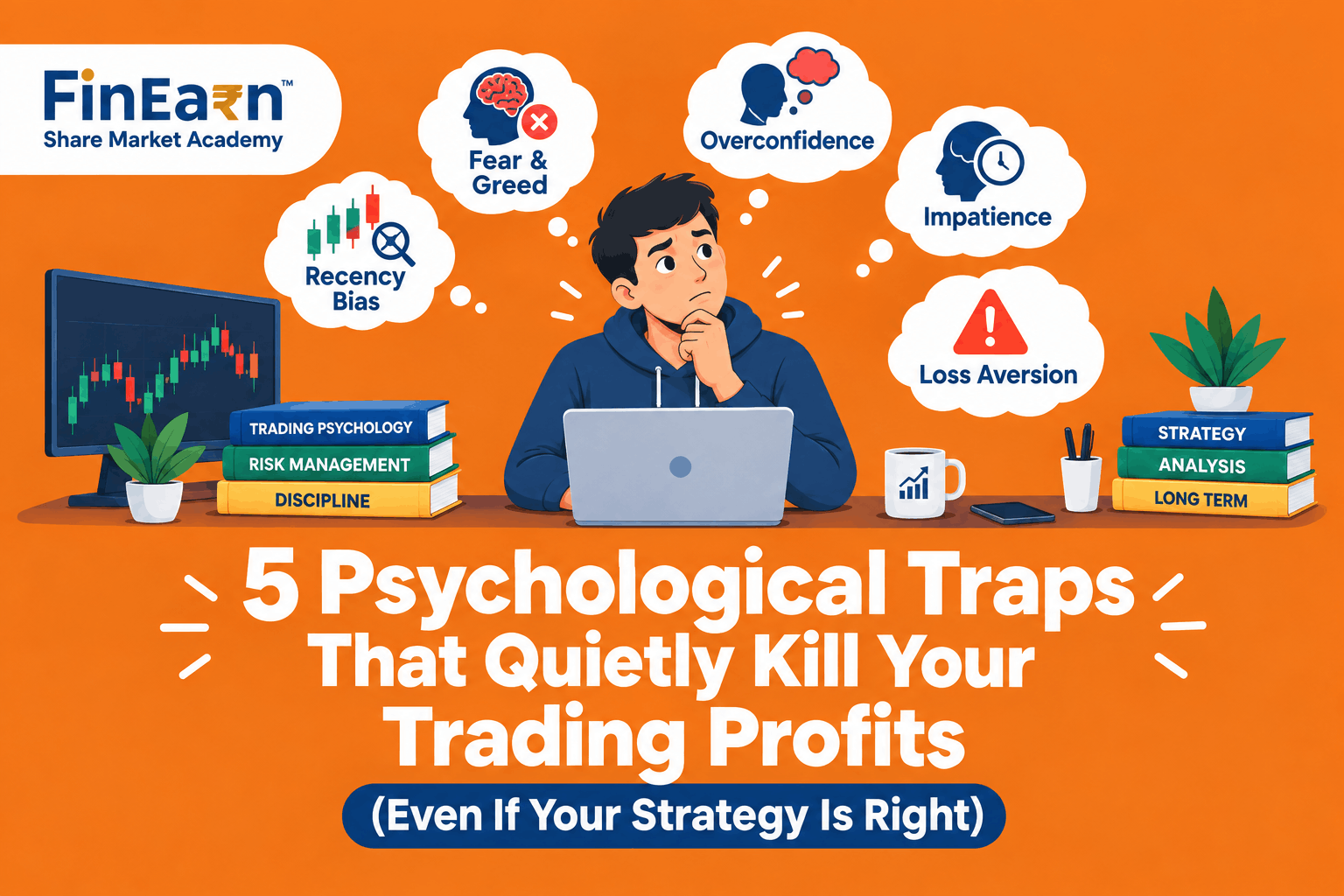
Behavioral economists have a name for this — loss aversion — and it explains one of the most common (and costly) habits in trading. Losing money hurts psychologically almost twice as much as gaining the same amount feels good. So what do traders do? They hold onto losing positions far too long, hoping the stock “comes back,” while they sell winning positions too early just to lock in a small, safe gain.
The result is a portfolio full of small wins and a few devastating losses — the exact opposite of what a profitable trader wants. The fix isn’t willpower; it’s mechanical rules. Decide your stop-loss and target before you enter a trade, write it down, and follow it regardless of how you feel in the moment.
2. Revenge Trading
You take a loss. It stings. Instead of stepping back, you immediately jump into another trade — often bigger, often less researched — hoping to “win it back” quickly. This is revenge trading, and it’s one of the fastest ways to turn a manageable loss into an account-ending one.
The tell-tale sign is speed: if you’re entering a new trade within minutes of a loss, without your usual checklist, you’re not trading anymore — you’re reacting. Experienced traders build in a mandatory cooling-off period after any loss beyond a certain size, even if it’s just 30 minutes away from the screen.
3. Confirmation Bias
Once you’ve decided a stock is going up, your brain becomes remarkably good at finding reasons to agree with itself. You’ll notice the bullish news and skim past the bearish news. You’ll follow analysts who confirm your view and mute the ones who don’t. This is confirmation bias, and it’s dangerous precisely because it feels like “doing research.”
A practical fix: before entering any trade, actively write down the strongest argument against your position. If you can’t come up with one, that’s often a sign you haven’t looked hard enough — not that the trade is bulletproof.
4. FOMO (Fear of Missing Out)
A stock has already run up 15% today, it’s trending on social media, and everyone in your trading group is posting screenshots of their gains. You jump in near the top, without a plan, purely because you’re afraid of missing the next leg up. More often than not, that’s exactly when the move ends and you’re left holding the bag.
FOMO trades share a pattern: they skip your normal checklist, they’re driven by other people’s excitement rather than your own analysis, and they usually involve a smaller time horizon for research than your typical trade. If you notice you’re breaking your own rules to get in “before it’s too late,” that’s the moment to pause, not act.
5. Overconfidence After a Winning Streak
Paradoxically, a string of wins can be more dangerous than a string of losses. Success breeds overconfidence, and overconfidence leads to bigger position sizes, fewer checks, and skipped stop-losses — right before the market humbles you. Many traders can point to their worst-ever loss and trace it back to a winning streak that made them feel invincible.
The discipline here is almost boring: keep your position sizing and risk rules identical whether you’ve won your last five trades or lost them. Consistency, not confidence, is what compounds.
Why This Matters More Than Most Beginners Realize
New traders spend 90% of their learning time on strategy — chart patterns, indicators, entry and exit rules — and almost no time on the psychological side. But strategy only works if you can execute it consistently, and consistency is a psychological skill, not a technical one. This is why so many traders who can correctly explain RSI or moving averages on paper still lose money in live markets — the gap isn’t knowledge, it’s discipline under pressure.
Building Better Trading Habits
A few practices that genuinely help:
- Keep a trading journal. Record not just entry/exit prices, but why you took the trade and how you felt at the time. Patterns in your emotional triggers will surface within weeks.
- Predefine every trade. Entry, target, and stop-loss decided before you place the order — not adjusted mid-trade based on emotion.
- Trade smaller when uncertain. Reducing position size during volatile or emotionally charged periods protects your capital while you regain composure.
- Review weekly, not just daily. A single bad day feels huge in the moment; a weekly review shows the real pattern.
Final Word
The market doesn’t care about your feelings, but your feelings absolutely affect how you trade the market. Strategy gets you a plan — psychology determines whether you actually follow it.
At EMS Share Market Classes in Pune, our mentorship goes beyond charts and indicators — we work with students on real risk management and trading discipline through live practical sessions, so the habits you build in class actually hold up when real money is on the line. Call us at +91 9561861818 to learn more about our Basic to Advance Masterclass.